
Day & Night: How Infection Changes Our Biological Clock
The body’s internal clock shapes far more than sleep—it can influence how we respond to infection, vaccines, and treatment. At UC Santa Cruz, researchers have discovered that even “dead” bacteria can disrupt this delicate rhythm, suggesting that timing might play a bigger role in health than we realize, Farah Aziz Annesha reports. Illustrations by Jacquie Villa Rajerison and Julia Devine.

These are some of the mysteries that chronobiologists, or scientists who study biological rhythms, have been trying to solve for decades. All questions lead to the same destination ─the clock ticking away inside each of our cells. The circadian clock controls our internal 24-hour rhythm, which in turn controls different aspects of our physiology, including sleep patterns, metabolism, body temperature, hormone production and immune response. Studies suggest the circadian clock controls 30% of all mammalian genes, which means that it affects more than half of our biology, due to how interconnected our genes and biological systems are.
Chronobiology is starting to knock on the door of many disciplines
Now, Jacqueline Kimmey and her colleagues at the University of California, Santa Cruz have been working to figure out how and why bacterial infection affects the host circadian clock and vice versa. Since, 2019, her lab has been studying how the bacteria Streptococcus pneumoniae impacts circadian rhythm.
Her recent study on zebrafish cells has shown how heat-inactivated Streptococcus pneumoniae, even when “dead,” can alter the circadian clock of the host. This is unprecedented, as previous research has only shown how active bacteria can change circadian rhythm. “I don’t think anyone up until this study has really looked at what impact the bacteria has on the clock itself,” says John F. Brooks, a researcher at Princeton University who studies circadian clock regulation of innate and adaptive immunity. “She has identified this new mechanism by which microbial components in and of themselves can [directly] influence clock components.”
Circadian rhythm “is such a huge part of biology that we are not paying attention to,” Kimmey says. “Vaccine responses will be stronger or weaker depending on the time of day you got vaccinated. There’s very strong data that suggests the time you might be exposed to a respiratory infection can impact how sick you might get.”
A pivotal shift
The granular understanding of how circadian rhythm works has eluded scientists for centuries. In 1935, two highly observant zoologists, Hans Kalmus and Erwin Bünning, noticed that drosophila flies emerge from their pupae at around the same time near dawn. Their discovery of the circadian rhythm laid the groundwork for genetic studies to follow.
With the advent of gene-sequencing technology in the 1970s, two geneticists, Ron Konopka and Seymour Benzer identified the first clock gene, period (per), in Drosophila melanogaster fruit flies in 1971, proving that circadian rhythm was controlled by genes. Since then, decades have passed as scientists have strived to understand the intricacies of the circadian clock, what it does and how it works. They are now moving onto the next major question: what and how does the circadian clock impact the biology of organisms?
In 1969, a scientist named Ralph D. Feigin flirted with the idea of how circadian rhythm impacted mice. He investigated how the time of the day when mice are infected with a bacteria impacted their survival. His results showed that mice were more resistant to the bacteria during their active hours. This brief question that prodded at the intersectionality of immunity and biological rhythms was then forgotten, as more pressing questions 一 such as how does the clock work 一 took precedence.
Decades later, a young Kimmey wanted to know the answer to a simple question: why do people get sick? In search of answers, she followed down a path that led her to studying bacterial pathogenesis – how bacteria can lock onto a cell, invade it and take over the cell machinery to reproduce its clones, eventually causing cell death. But a fated meeting at a conference would shift her future towards the same path as Feigin and other chronobiologists before her.

Photo credit: Carolyn Lagattuta
During her postdoctoral studies, Kimmey crossed paths with Jason Rosch, a principal investigator with the St. Jude Children’s Hospital Department of Host Microbe Interactions, while presenting her work at a scientific conference. Rosch told her to keep the time of infection consistent in her experiments, because infecting cells in the morning versus the afternoon might yield different outcomes. This was startling to Kimmey, as she’d never considered timing as a variable in her decade of prior research.
Two years later, in 2019, soon after Kimmey joined UCSC, she had another pivotal conversation that left her with more questions than answers. Carrie Partch, a UC Santa Cruz researcher who studies the mechanisms of circadian rhythm, enlightened Kimmey, who was new to this field, what the circadian clock was. She formed a collaboration with Partch to investigate how S. pneumoniae infection altered the circadian clock.
Less than a year later, in early 2020, Kimmey had an unexpected breakthrough. While conducting an experiment on mouse cells that is yet to be published, she wanted to rule out the possibility that infection can alter the cell molecular clock. To prove this, she set out to perform a negative control study, using heat-killed S. pneumoniae to infect the mouse cells. But unexpectedly, she stumbled upon a new finding: the heat killed bacteria repressed the circadian clock of the mouse by increasing circadian gene expression. In other words, even “dead” bacteria could “talk” to the host cell and alter its circadian rhythm. This left her astonished and excited all the same.
Propelled by her new discovery, Kimmey attempted to recreate the same experiment on a different organism which she already used in her lab: zebrafish.
The day and night of a zebrafish
The door to Kimmey’s lab in the UCSC Biomedical Sciences building is covered with a black tarp, with a dual-sided sign. One side reads: “DARK ROOM IN USE: DO NOT OPEN DOOR.” Inside the lab are incubators, fridges, microscopes, gas cylinders and lab equipment — all tools to study the circadian clock of bacteria-infected zebrafish. Every light-emitting screen and surface is covered with a black cloth, while a red light hangs overhead.
On top of a desk stands two circadian incubators, nicknamed Charlie and Carlos. A sticker on their front proudly boasts their unique ability: “I can automatically cycle temperature and light.” Charlie’s light cycle runs from 9am to 9pm while Carlos’s light cycle runs from 11pm to 11 am.
Inside Carlos and Charlie are petri dishes that contain black dots floating over a solution. The dots are 2-day-old zebrafish larvae. When placed under microscopes, they appear as miniscule tadpoles wrapped inside a circular, transparent film. As they develop, the zebrafish break out of the film, and swim around in the solution.

Zebrafish larvae under a microscope
Fénero stores the fish inside the circadian incubators to synchronize their circadian clocks to the controlled light and dark phases. Zebrafish are very sensitive to light, as their entire body is covered in light receptors, unlike mammals, who only have light receptors in their eyes. After three days of repeated light and dark cycles, she takes them out and injects them with inactivated Streptococcus pneumoniae bacteria.
These zebrafish are genetically modified to include a reporter gene that contains luciferase, a light producing enzyme. This reporter gene lights up every time the circadian genes are expressed. Automated software detects and records this data every four hours, gathering information on how much the genes are expressed over 48 hour intervals.
Gene expression is important in this experiment as these circadian genes control the circadian rhythm of the zebrafish. Two proteins—CLOCK and BMAL1—form a complex that acts like a switch to “turn on” specific genes including PER and CRY. These genes produce per and cry proteins that gradually build up over time and eventually inhibit CLOCK and BMAL1, effectively “turning off” their own production. With time, the per and cry proteins breakdown, allowing the CLOCK-BMAL1 duo to “turn on” the genes again, and the cycle repeats.
This cycle continues independently of light, but light helps keep the clock aligned with the external environment. Specifically, light can induce the expression of light-sensitive genes like PER2 and CRY1, helping to reset or synchronize the clock to day-night cycles. So, while the clock runs on its own, light acts like a tuner, adjusting the timing of the “on” and “off” phases to match sunrise and sunset.
When the experiments first began in early 2020, Kimmey did not have the technologies necessary to automatically take readings at 4 hour intervals. So her team had to use a manual method to collect zebrafish cells and take readings every 4 hours.
“We stayed here [in the lab], slept on the couch, woke up every 4 hours, collect cells and take readings, then sleep again” says Fénero. She explained how they had to collect readings in the dark, in very dim red light as it was the only light that did not activate the circadian genes.
“The investigator has to sacrifice their own circadian rhythm,” says Kimmey.
The results of the research were unexpected. When given “a whiff” of S. pneumoniae, “the off-switch was way louder for some reason,” says Kimmey. This showed that even when uninfectious, bacteria can still inflict changes on an organism’s circadian rhythm. Light conditions also change how bacteria affect these rhythms, which could help explain why time of day impacts immune responses.
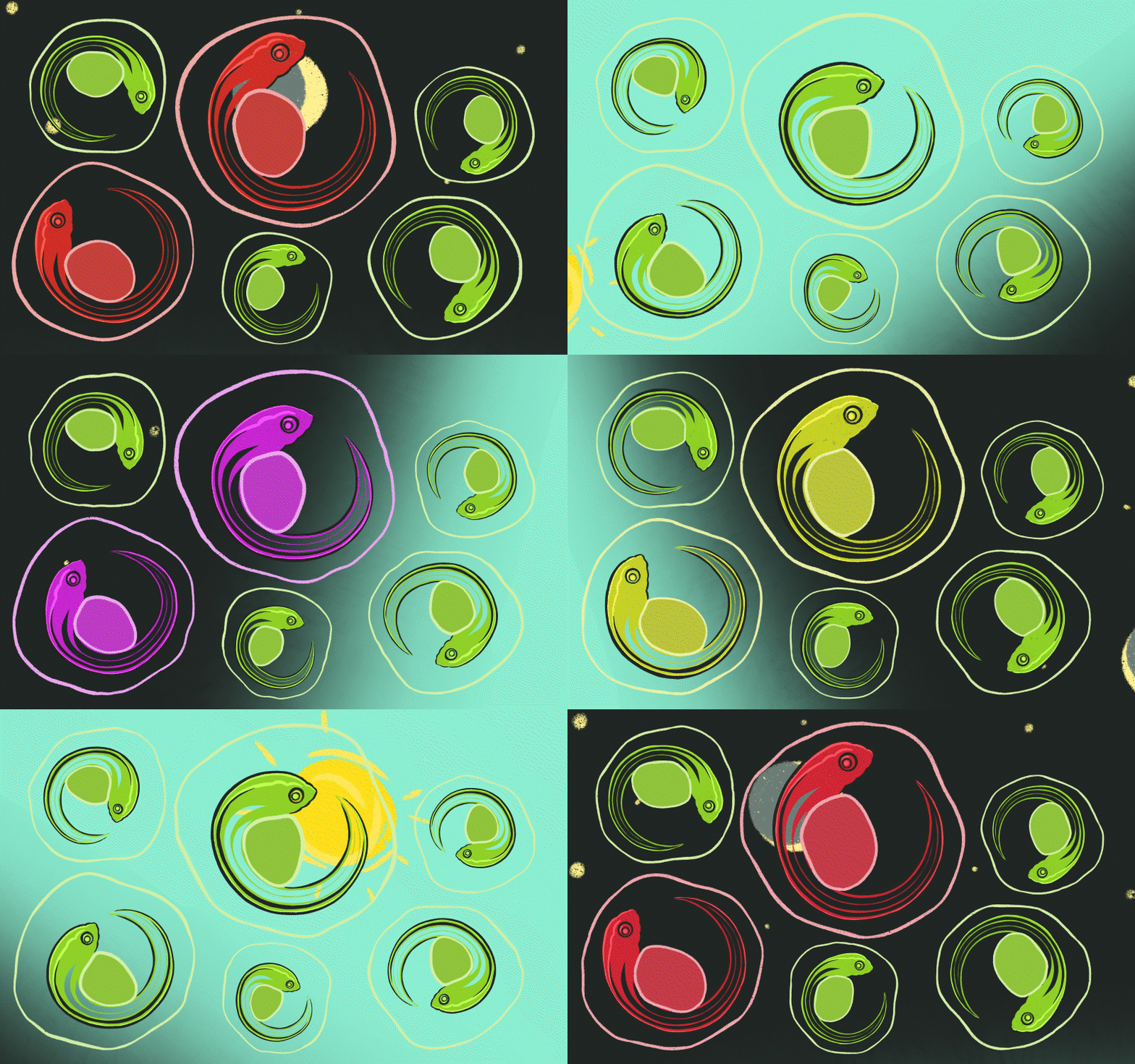
How infection with inactive bacteria affects the day and night of a zebrafish. The “off” switch is much louder. Illustration: Julia Devine
Vaccine responses will be stronger or weaker depending on the time of day you got vaccinated.
In addition, Kimmey suggests, the time when drugs such as antibiotics and therapeutics are administered might make a marked difference in their efficacy. Furthermore, understanding circadian rhythm more completely might change the way scientists conduct experiments. Scientists might have to repeat experiments twice, thrice or four times in one day and at all times of the day to prevent circadian rhythm from becoming an unintended variable, Kimmey says.
Currently, Kimmey and her team are studying the underlying mechanisms of how infections affect circadian clocks in mice. Their unpublished work is testing whether or not circadian-microbe dynamics work in the same manner in mice and mice cells. Kimmey believes they will find interesting results for this project as well.
Overcoming an obstacle course race
Kimmey’s road to her research findings was filled with multiple obstacles.

Kimmey in the zebrafish facility she made from scratch │Carolyn Lagattuta
When she arrived at UC Santa Cruz in 2019, the university did not have a zebrafish facility that she could use for her research. Zebrafish were a perfect model for her as they were transparent and could be used to observe systemic infections such as sepsis, which caused the zebrafish’s body to turn red. So Kimmey created a zebrafish lab from scratch. But just as she was putting the finishing touches on her fish facility, in February 2020, the COVID-19 pandemic hit, causing her to delay the start of her research for four months.
Then, in August 2020, another calamity hit. The CZU Lightning Complex wildfire erupted across San Mateo and Santa Cruz counties due to lightning and burned nearly 90,000 acres in Northern California for 37 days. Everyone at UC Santa Cruz were ordered to evacuate. When Kimmey heard the news, all she could do was tell her students to stop their work and put everything in the freezer. “I remembered thinking that if the lab burns down, I am done,” she says.
As for the fish, Kimmey could not leave them behind. At that time, she was notified that the campus would be closed for two days. “I called my friend, asking her how long zebrafish could survive without food,” she says, “The answer was zero.”
So Kimmey drove her jeep to the lab, scooped the fish out of their tanks and took them home. There, on her kitchen table, she set up a makeshift zebrafish facility. For three weeks, the fish lived there, with a space heater to keep a constant temperature and a sous vide to warm the water. “Overnight, my entire kitchen had turned into a fish facility,” Kimmey said.
These obstacles set her back months, but have also helped her gain experience in navigating obstacles to her research. In 2023, Kimmey had another evacuation scare when heavy storms prevented several of her graduate students from coming to the lab. Although the situation was not as dire, by that point, Kimmey had gotten used to evacuating. She had memorised all the fire exits, all the protocols – in case she had to run again, she said.
A promising future
In the meantime, other researchers are also pivoting to studying the intersection of immunity and circadian rhythm.
“I think there’s a lot of timing cues that are intrinsic to immunity that we’re beginning to unfold,” says John F. Brooks, a researcher at Princeton University who studies circadian clock regulation of antimicrobial proteins in the intestine. “This is going to begin to drive the way in which we perform therapy and the way in which we administer medicine”.
And Filipa Rijo-Ferreir at UC Berkeley has been studying the relationship between circadian rhythm and parasitic infections. Her work has shown that parasitic infections can alter the circadian clock, where they make “the clock tick faster”, she says. “There has been a very recent explosion of a lot of new information, a lot of new studies that really connect the circadian clock to infection, [but] I think it’s still in its infancy,” she says. She points out that some of the ideas of circadian rhythm have already entered mainstream medicine. In hospitals, for instance, newborn babies are trained into a rigorous day-night cycle by covering their heads during nighttime. This leads to babies being discharged much earlier and gaining more weight.
“Chronobiology is starting to knock on the door of many disciplines,” says Paola Tognini, a researcher studying the intersection of circadian clock and neurodegenerative disorder. She believes a crucial next step of this field is to find out how to translate the findings into human medicine.
One of the field’s biggest challenges is the cost of experiments, since they must be run repeatedly across the circadian time cycle “For my work, I essentially multiply the number of reagents by six timepoints,” says Brooks via email.
As for Kimmey, navigating so many challenges in her research has taught her to keep going irrespective of the obstacles that arise. Now, she hopes that she’s poised to pursue her goal of discovering more about how our body clocks behave in health and disease. “If you get too gun-shy and stop at every second, it would literally be impossible to have done absolutely anything,” she says, “You’ve just got to keep doing it while you can.”
© 2025 Farah Aziz Annesha / UC Santa Cruz Science Communication Program

Farah Aziz Annesha
Author
Internships: Monterey Herald, Stanford Report
”Why can’t I smell or taste anything?”
My sister’s question, asked dejectedly after she tested positive for Covid, propelled me to find answers. I was also sick with Covid, so reading research papers was out of the question. Then, by luck (or perhaps destiny), I found a well-written article explaining Covid anosmia: the loss of smell caused by the coronavirus. That is how I first learned about science writing.
It is the best of both worlds for me. I have a background in science and an intense passion for writing. Through science writing, I can break the age-old stereotype in my country, Bangladesh: “Science can only be understood by scientists and doctors.”
But why should science be limited to people in STEM?
Why should families force their children to become doctors and scientists just so they can help make medical decisions for the family? I aspire to change this culture and make science accessible to everyone in my community.

Jacquie Villa Rajerison
Illustrator
B.S. (Marine and Coastal Science), University of California, Davis
Internship: Monterey Bay Aquarium
Jacquie Villa Rajerison (she/her) is a marine ecologist and science illustrator who aspires to create immersive marine art, drawing her viewers into an oceanic adventure. At 11 years old, she met a leopard shark and has proceeded to be fascinated by the ocean ever since. Her love of communicating sea-related stories flourished while working on rocky intertidal research projects; both as an undergraduate student at UC Davis and as a lab assistant at Bodega Marine Lab.
You can often spot her knee deep in tide pools, crawling like a crab among the rocks to research and sketch marine invertebrates such as anemones, snails, and sea slugs. Scientific illustration is an essential tool to reach her larger goal of using multi-modal and visual communication tools to increase public access to science.
Instagram: @Comsic_Cuttles

Julia Devine
Illustrator
B.F.A (Illustration), California State University Long Beach
Internship: Monterey Bay Aquarium Research Institute
Julia Devine is an illustrator from Sacramento, CA, with a BFA in Illustration from California State University Long Beach. Growing up on the pacific coast, Julia was constantly exposed to the creatures that call California home and often found herself taking inspiration from them in her art.
It was at California State University Long Beach where her passion for science illustration was discovered. After taking a biomedical rendering class, Julia was sold on the idea of using art to communicate complex science topics. Her mission is to one day work alongside researchers and educational experts to develop visuals for both scientific research and public outreach.
Instagram: @j_devi_art